 Ah, road safety!
The FIA claims a mandate for safety around the world before a remit to deliver the sporting framework for F1, or any other motor racing category. Given the horrors of the past century it is commendable how much progress has been made. That much of this progress is down to Sir Jackie Stewart, Professor Sid Watkins, Niki Lauda, and the classic era of Max 'n' Bernie rather suggests it was not all down to the heavy lifting of the FIA.
Some years back I remember Michael Schumacher strapping into a simple sled-like simulator. Once buckled-up in a robust car seat he was propelled into a barrier for an abrupt stop at something like 20 kph. Michael was shocked at how abrupt that was without all the jolly safety features of F1. So, race safety, and road safety are our two peas in a pod to be mushed with vinegar into today's adventure.
Miss Physics, who has been too long from these pages, has a veritable Alpha to Omega of relationships, calculations, and constants with which to define, monitor, and predict the physical world. It is after all, her complete Universe.
Years back while returning from a lunchtime stroll to my favourite cycle shop in all of Australia (based opposite a rose garden in Nedlands an inner-city suburb) just as I reached a cross roads with traffic light control, a Volvo screamed through the junction from a side road and executed a violent right turn onto the main through road, being a dual-carriage way. All good in the normal run of things. Except in this instance he had crashed a light so red. The light for the main carriage way was already green, and a near-new Hyundai sedan, which had been slowing to a stop, was able to accelerate as the light went green... then swerve wildly to avoid the errant Volvo. The abrupt course correction resulting in crashing directly into one of the traffic light poles with a sickening thud only those that have been in an accident know.
This unfolded right in front of me. About eight or ten of us dashed to the stricken vehicle. Inside was an old lady slumped over the wheel. The impact had been so low speed none of the airbags had gone off. The owner of a shop on the corner of the lights came flying out the door yelling; "I know advanced first aid! Let me through!" We did. As he eased the dear lady to the ground and started trying to revive her it was clear she had passed. Gone from a mild crash that had not even set off the airbags. Indeed, the car still looked quite drivable. It was not an enjoyable lunch break any more.
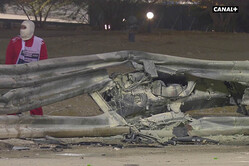
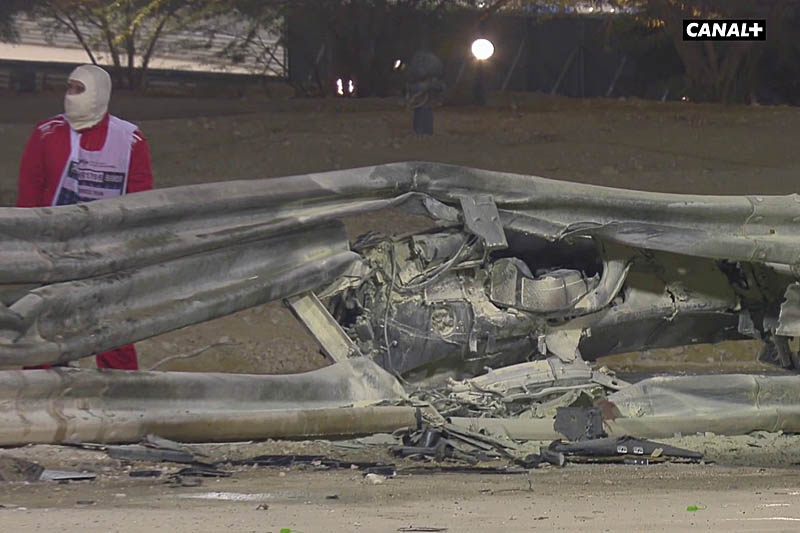
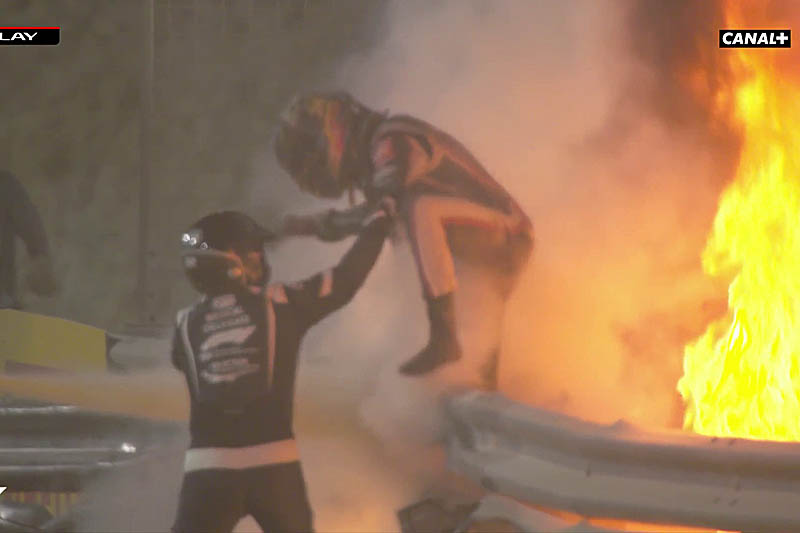
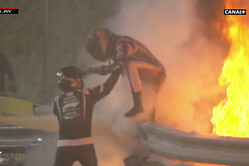 How can Romain Grosjean survive a 300 kph horror, or Mika Hakkinen his flying Adelaide crash, yet this dear old lady did not survive a 15 kph unscheduled abrupt halt?
Physical condition. Safety cells. Restraint mechanisms. Road rules. Driving habits. Age. Environmental conditions.
No crash has a single cause. Always factors combine to create the awful moment.
Has the FIA moved the needle on safety? Or was it more like Sir Jackie Stewart, Prof. Sid Watkins, Niki, Bernie and Max over the years? Let's be generous and say each has made a contribution.
Back to Miss Physics. Kinetic energy in a Newtonian Universe can be defined as "Kinetic energy equals half the mass multiplied by the square of the velocity". Thus, there is a direct relation to the mass, but a squared relationship to velocity. Double the mass of the object and you double the kinetic energy. Double the speed, ah, now you've quadrupled the KE. This happens because the velocity is squared... so double the speed generates four times the kinetic energy. Ouch!
So, for a 2025 F1 car and driver weighing around 850 kg we have a KE at 100kph around 327,932 Joules (J). Move up to 200 kph and we arrive at 1,311,728J, and at 300 kph 2,951388J. Big numbers!
Alternately, if we return to 100 kph, but double the mass we 'only' move to 655,864J, half the increase of moving to 200 kph.
Why all this fun with maths? Well, all those Joules have to go somewhere in a crash. It is dissipating this energy which causes all the damage. Simply turn the engine off and coast to a stop? Friction both between car parts and with the air and the road, will dissipate that energy very slowly. It will be a stately slow glide to a standstill. The faster one wants to dissipate the energy the more violent the stop becomes. Lifting off the throttle in a current F1 car generates several g of deceleration due to the massive drag of a current car. Slam on the brakes too, pushing all that energy via friction into brake disk heat, and the rate of deceleration is something none of us dear reader will have experienced on the wildest of rollercoasters. A rough guide is that an F1 car can pull up to 4g accelerating, 6.5g under maximum braking, and around 5g to 6g cornering. For comparison in normal operation commercial planes do not exceed 1g in any manoeuvre, and are only designed to withstand up to around 3.75g.
Road cars? Anything approaching 1g for any of cornering, braking, or accelerating is huge for a road car. The McLaren Senna hypercar can manage 2.1g under braking which is massive.
Back to our 850 kg F1 car at 100 kph. Let's drive it directly into a barrier. Both the barrier and the front of the car deform, meaning the driver goes from 100 kph to zero over 2 metres. The resulting g force? Around 19.7g...! Massive. To stop within those two metres we had to decelerate at a rate of -192.9 m/s2.
This is why modern cars deform so much in crashes, to absorb more of the energy, and allow the passenger cell a longer time, and a greater distance, over which to drop speed. It's also why what you hit makes a huge difference. A 900 kg Renault Clio smashing into a 3,000 kg Dodge Ram suffers so badly because the huge mass of the Ram can move much slower while absorbing the same amount of energy. The two vehicles share the energy 50% each post contact, meaning the Clio must move much faster/deform more to equal the energy soaked up by the Ram.
Same in F1. Romain Grosjean and Mika both walked away from horrendous crashes because a modern F1 car and modern crash barriers combine to give maximal cushioning to the driver. Yet, the driver then needs to be fit and healthy enough to survive the massive g experienced. All while not knocking any of his 'soft breaky bits' on the heartless carbon fibre of his cockpit. Hence belts, helmets, and HANS devices.
Yes. The FIA, Sid, Jackie, Niki, Bernie, Max and a host of others have progressed greatly on the safety front for F1 since the 1960's and prior. Never before have we had so many drivers retire safely from the sport and go on to lead long, healthy lives.
Has the FIA performed a master work of moving all these safety developments on to public roads around the world? I'd venture not.
The FIA sanctioned race tracks of the world are far safer now than ever, yet our public roads remain more deadly than they need be due to a mix of casual indifference, greed, and government irritation at the complexity of the problem.
Better road design costs more. Quality barriers cost more. Flyovers (don't cross the streams!) cost way more to build that four-way stops, or traffic lights. And governments love placing all the blame on drivers and then fining us for 61 in a 60 zone to the glorious ring of the cash register.
Finally, we have driver behaviour. Each country within which I've driven has a different set of bad habits. Yet the very worst crashes tend to involve excessive speed, mental issues, illegal behaviour and drink and/or drug influenced driving... often in stolen vehicles. As I like to remind people, "Stupidity. Deadly at any speed."
It is not a question of how fast you are travelling which can be dangerous... it is a question of how rapidly you intend to stop. Just ask Miss Physics.
Max Noble
Learn more about Max and check out his previous features, here





sign in